Mental Health & Wellness
Decision Paralysis: How a Two-Choice Tarot Spread Can Help You Decide
June 14, 2026
Modern life presents us with an overwhelming volume of choices. Should you stay at your stable corporate job or leap into freelancing? Should you renew your lease in Austin or move to a new city? Should you commit to a relationship or walk away?
When both options carry pros and cons, your brain can easily lock into decision paralysis. You analyze the possibilities endlessly, make pros-and-cons lists, ask friends for advice, and end up feeling even more confused than when you started.
When logic reaches a stalemate, a simple Two-Choice Tarot Spread can act as a circuit breaker for your overthinking mind.
The Psychology of the Two of Swords
In tarot, decision paralysis is perfectly illustrated by the Two of Swords. The card shows a blindfolded woman seated on a stone bench, holding two heavy swords crossed over her chest. Behind her lies a stormy sea dotted with jagged rocks.
The blindfold represents her refusal to look at the situation, while the crossed swords block her emotional heart space. She thinks that by refusing to choose, she is keeping herself safe. In reality, stalling keeps her stranded on a cold stone bench while the tide creeps in.
Indecision is a decision; it is a choice to stay stuck.
Anatomy of the Two-Choice Spread
The purpose of a Two-Choice Spread is not to have the cards pick your future for you. Rather, it projects the probable energy, challenges, and emotional trajectory of each option so your intuition can recognise which path truly aligns with your core values.
Lay out your deck in two distinct rows:
[ Center: Your Core Motivation ]

   Path A (Option 1)              Path B (Option 2)
[ Card A1: Immediate Energy ]  [ Card B1: Immediate Energy ]
[ Card A2: Hidden Challenge ]  [ Card B2: Hidden Challenge ]
[ Card A3: Long-term Growth ]  [ Card B3: Long-term Growth ]
Step 1: The Anchor Card (Center)
Before examining the paths, draw a single center card answering: "What is my true underlying priority right now?"
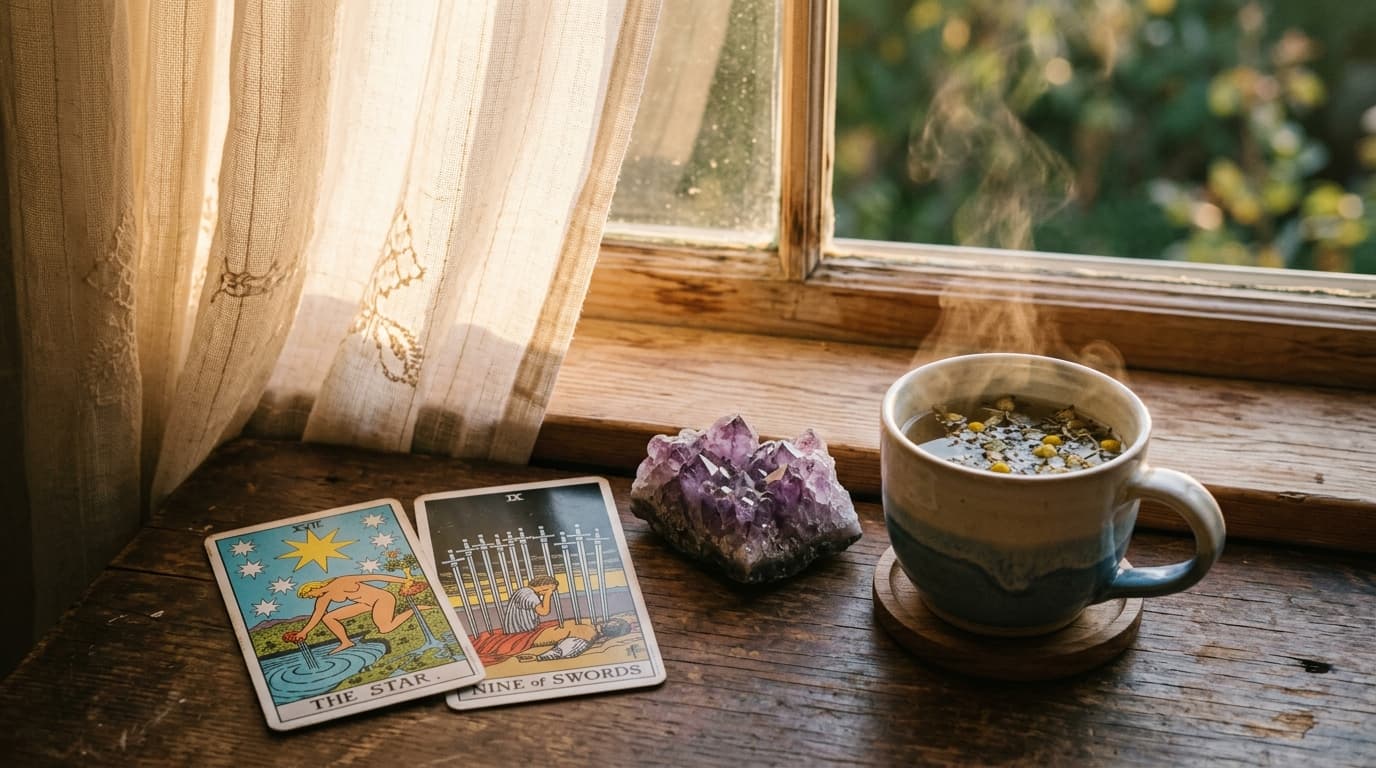
- If you draw The Star, your real priority is peace and healing.
- If you draw The Chariot, your priority is career momentum and victory.
Knowing your baseline motivation makes comparing Path A and Path B much easier.
Step 2: Compare the Trajectories
- Path A Cards: Look at how Option 1 feels. Does it bring the structured stability of the Four of Wands, or the weary conflict of the Five of Swords?
- Path B Cards: Examine Option 2. Does it spark the creative fire of the Page of Wands, or the financial worry of the Five of Pentacles?
We explored similar practical applications of tarot in our article on reading tarot for yourself vs. others.
The "Flipped Coin" Intuition Trick
Here is a secret that experienced tarot readers know: Pay close attention to how you feel the moment the cards are revealed.
If Path A reveals bright, successful cards like The Sun and you feel a wave of disappointment, your subconscious is telling you that you secretly wanted Path B all along. If Path B shows challenging cards like The Tower and you feel relieved, your intuition is confirming that you were looking for an excuse to walk away from that option.
The cards aren't deciding for you; they are acting as a mirror that forces your hidden preference into the light.
Stuck at an intimidating crossroad in your career, relationship, or personal life? Book a decision-clarity session with Austin Tarot Reader today.
✨ Want to go deeper?
Book your personalized tarot reading with Austin Tarot Reader today.
Book a Reading