Tarot History
The History of the Rider-Waite-Smith: The Hidden Woman Behind the Art
November 11, 2025
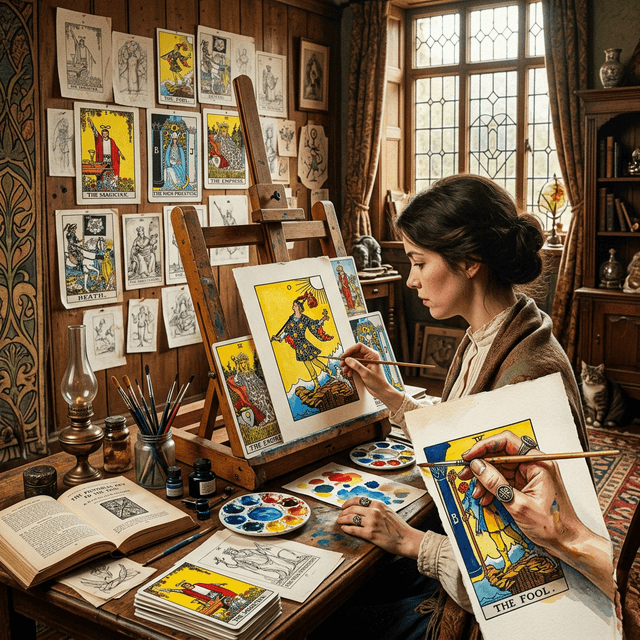
If you’ve ever seen a tarot card, chances are you’ve seen the work of Pamela Colman Smith. The deck she illustrated in 1909, known for decades simply as the "Rider-Waite" deck, remains the global standard for tarot imagery.
Yet, for over half a century, the woman responsible for the iconic, vibrant scenes that allowed tarot to move from the elite rooms of occultists into the hands of the public was almost entirely erased from the history of her own work. This is the story of "Pixie" and the revolution she painted.
The Revolution of the Pips
Before 1909, most tarot decks looked very different. The "Minor Arcana" (the suits of Wands, Cups, Swords, and Pentacles) were usually represented simply by the symbols of the suit. A "Three of Cups" was just three cups on a background.
Under the direction of mystic Arthur Edward Waite, Pamela Colman Smith did something radical. She illustrated every single card with a narrative scene. She gave the cards life, motion, and human emotion. This change transformed tarot from a complex mental exercise into a deeply intuitive tool.
Who Was Pamela Colman Smith?
Born in London to American parents and raised in Jamaica, Pamela was a woman of extraordinary talent and diverse influences. Known as "Pixie" to her friends, she was an artist, an author, and a storyteller with a flair for the theatrical. She was a member of the Hermetic Order of the Golden Dawn, where she met Waite.
Her Jamaican upbringing and her synesthesia (the ability to see color in music) heavily influenced the bold, flat colors and stage-like compositions of the deck. When she painted the cards, she wasn't just following instructions; she was weaving together a lifetime of multicultural art and mysticism.
The Erasure: Why "Rider-Waite"?
The deck was originally published by the Rider Company, under the name of A.E. Waite. For decades, Pamela’s name was omitted from the title of the deck. Even as millions of people used her art to strengthen their intuition and navigate career transitions, she lived and died in relative obscurity, never receiving royalties for what would become a massive commercial success.
It was only in recent decades that historians and tarot practitioners began insisting on the name Rider-Waite-Smith (RWS) to properly honor the woman whose vision defined the modern era of tarot.
Legacy: A Language for the Unconscious
When we talk today about the psychology of tarot and Jungian archetypes, we are talking about images that Pamela Colman Smith brought to life. Her ability to translate abstract mystical concepts into human stories is what makes tarot such a powerful tool for shadow work.
When you look at the Death card and see the skeleton on the horse, or The Sun and see the child on the white horse, you are looking through her eyes.
Honoring the Source
The next time you pull a card, take a moment to notice the style: the thick lines, the stage-like foregrounds, the vibrant blues and yellows. You are looking at the legacy of a woman who changed the way we see the unseen.
Are you ready to explore the stories within your own life through the lens of this historic art? Book a reading with Austin Tarot Reader today and let's decode the messages Pamela painted for you.
Keywords: history of tarot, Rider-Waite-Smith deck, Pamela Colman Smith, Pixie Smith artist, history of RWS tarot, women in tarot history, tarot deck art, occult history, Austin tarot reader
✨ Want to go deeper?
Book your personalized tarot reading with Austin Tarot Reader today.
Book a Reading